
Thailand: the country nobody colonised.
Almost everything around it was taken by Britain or France. Siam was not. This is how a kingdom squeezed between two empires kept its flag, what it paid for that, and how to plan the trip from the UAE in 2026, including the new 30-day rule.
- 1855 The Bowring Treaty opens Siam to British trade
- 1861 Siamese ambassadors are received by Napoleon III
- 1868 Chulalongkorn becomes king and reigns until 1910
- 1893 French gunboats force their way up the river to Bangkok
- 1896 Britain and France agree to keep Siam's heartland as a buffer
- 1909 A treaty with Britain fixes today's southern border
- 1932 The absolute monarchy ends
- 1939 Siam officially becomes Thailand
A kingdom between two empires
By the 1880s the map of mainland Southeast Asia had two big landlords. Britain held Burma to the west and was pushing into the Malay peninsula to the south. France was building French Indochina to the east, in what is now Vietnam, Cambodia and Laos. In the middle sat the Kingdom of Siam, with its capital at Bangkok, and neither empire wanted the other to have it.
That fear is what saved the country. But Siam did not simply get lucky. It spent half a century working at it.
Say yes to everybody
The strategy was to give every power enough that none of them needed to take everything. In 1855 King Mongkut signed the Bowring Treaty with Britain, which opened Siam to British trade and let British subjects in the country be judged under British law rather than Siamese law. Similar treaties followed with France, the United States and others. Concessions to one power were balanced with concessions to the next.
It also meant showing up in the diplomatic world on its own terms. In June 1861 Siamese ambassadors were received by Napoleon III at the Palace of Fontainebleau, an occasion so unusual that the French painter Jean-Leon Gerome spent three years painting it.
The king who modernised
Mongkut's son Chulalongkorn became king in 1868 and ruled until 1910. Over those four decades he abolished slavery, centralised the kingdom's revenues and built a national education system. The point was not only fairness. A state with a modern administration, a tax base and clear borders was harder for a European power to describe as a place that needed to be "civilised".
1893: the gunboats
Diplomacy was not enough when France decided to push the border to the Mekong. On 13 July 1893 French gunboats sailed up the Chao Phraya river, fought their way past Siamese forts at Paknam and blockaded Bangkok. The Siamese government gave in. In the treaty of 3 October 1893 it ceded the land that makes up most of present-day Laos to France, and accepted a strip on the western bank of the Mekong where it could not station troops.
It was a humiliation, and it was also the moment the two empires realised how close they had come to a collision.
The buffer
In January 1896 Britain and France signed a declaration agreeing to respect the independence of the core of Siam, the valley of the Chao Phraya. Neither wanted the other's army on its border, so a neutral Siam in the middle suited both of them. Historians often call it a buffer state, and that is exactly the role it was given.
What it cost
Independence was not free. France took more territory in treaties in 1904 and 1907. In 1909 a treaty with Britain moved the four northern Malay states, Kedah, Kelantan, Perlis and Terengganu, into the British sphere, and in return Britain gave up some of the special legal privileges its subjects had held in Siam and a loan was agreed for a railway.
So the honest version of the famous line is this: Thailand was never ruled by a European power, and it kept its throne, its capital and its flag. It also became a smaller country than it had been, and it only got there by paying.
The 1932 revolution ended the absolute monarchy, and in 1939 the country officially changed its name from Siam to Thailand.
See the story for yourself
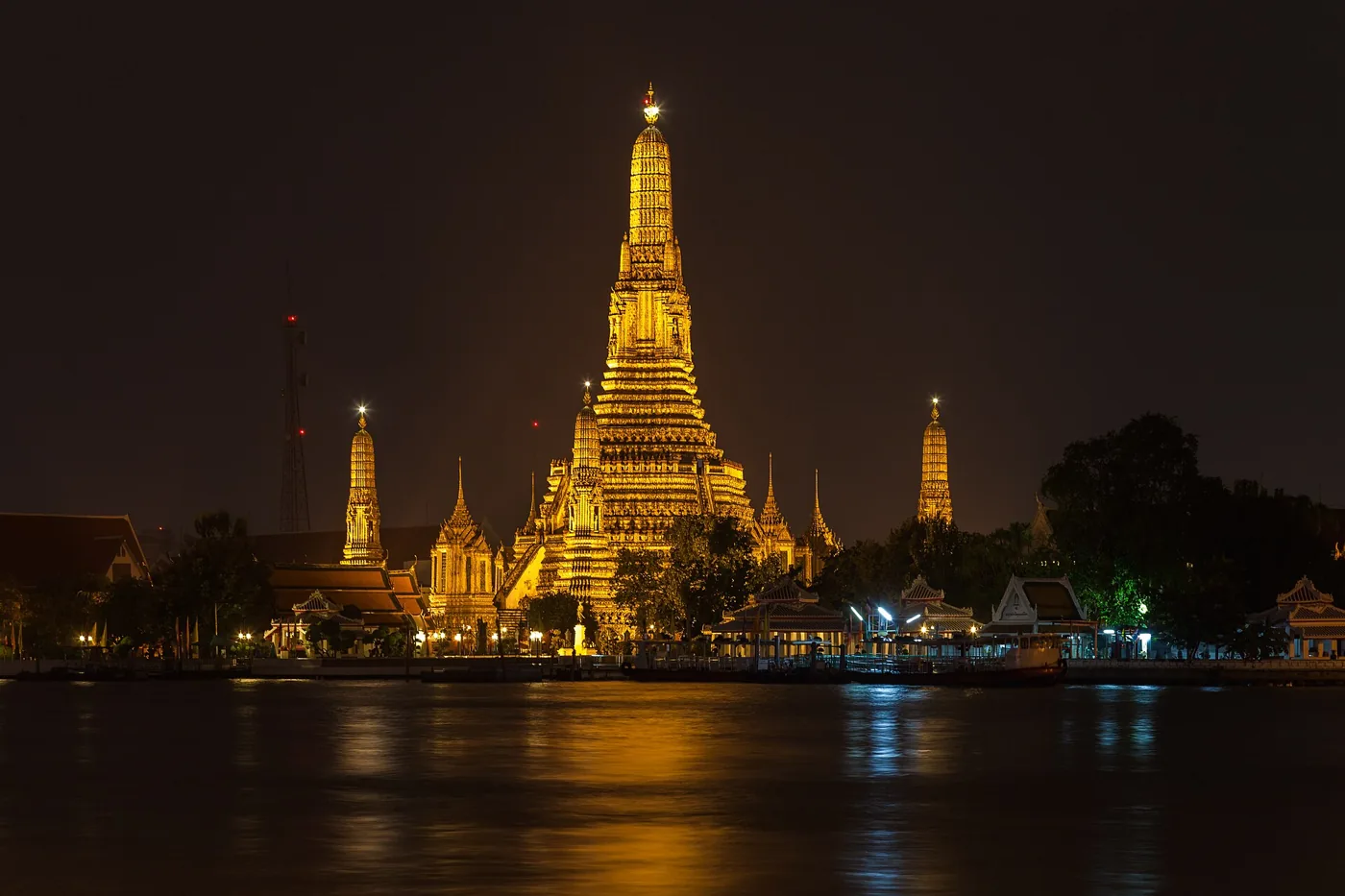
Bangkok is where all of this happened, and most of it is on or near the river.
Getting there from the UAE
- Flights. About six hours from the UAE to Bangkok. Compare Dubai to Bangkok flights.
- Entry for UAE passport holders. A valid UAE passport lets you enter for tourism without a visa for up to 30 days. The Royal Thai Consulate-General in Dubai lists this as effective from 15 September 2026, and it used to be 60 days. If your UAE passport was issued without nationality, you need a visa.
- If you live in the UAE on another passport, your own passport decides. The Thai rules are set by nationality, and many UAE residents travel on other passports. Check it on the Royal Thai Consulate-General's visa page before you book.
- Staying longer. A visa-exempt stay can be extended once by up to 30 days at a Thai immigration office, at the officer's discretion. The fee reported is 1,900 baht.
- The arrival card. Every traveller must complete the Thailand Digital Arrival Card online, within three days before arrival, at tdac.immigration.go.th. Use that address only: some look-alike services charge for the same form.
- At the airport. Carry your return ticket and your accommodation booking. Immigration can ask for them, and the decision to admit you is always the officer's.
- When to go. Roughly November to February is the cooler and drier season.
Before you fly
- Mobile data. Airalo sells a Thailand eSIM you can install before you leave.
- Travel insurance. EKTA travel insurance covers medical care abroad.
- A universal travel adapter. See universal adapters on Amazon.ae.
- Something to read on the flight. A Kindle weighs less than a paperback. Which Kindle to buy.
Questions people ask
Do UAE citizens need a visa for Thailand?
Holders of a valid UAE passport can enter Thailand without a visa for tourism for up to 30 days. The Royal Thai Consulate-General in Dubai lists this limit as effective from 15 September 2026, down from 60 days before. UAE passports issued without nationality need a visa.
I live in the UAE but hold another passport. Is it the same?
No. Thailand sets entry rules by passport nationality, not by where you live. Check your own passport on the Thai embassy's visa-exemption page before you book.
What is the Thailand Digital Arrival Card?
A free online form, called TDAC, that every traveller entering Thailand must submit within three days before arrival, at tdac.immigration.go.th. It replaced the paper arrival card on 1 May 2025.
Was Thailand ever colonised?
Never by a European power, which is why it is the one country in mainland Southeast Asia that was never colonised. It did lose large territories to France and Britain, and gave up legal rights, to keep that independence.
How long is the flight from the UAE to Bangkok?
About six hours.
The history is from the sources below. The travel tips are research from official and booking sites, not a personal trip report, and entry rules change, so check the Thai government pages before you fly. Links to tickets, tours, flights, eSIMs and insurance may earn me a commission through Travelpayouts, and Amazon.ae links through Amazon Associates, at no extra cost to you. The embassy, TDAC and Wikipedia links are plain links. Full disclosure.
Sources
- Visa Exemption / Visa on Arrival, Royal Thai Consulate-General, Dubai (official, effective 15 September 2026)
- Official Announcement: TDAC, New Entry Requirement for Thailand, Royal Thai Embassy, Kuala Lumpur (official)
- Thailand visa-free entry: new rules for UAE residents, The National, 15 September 2026 (extension and fee)
- 1893 Franco-Siamese crisis, Wikipedia
- Anglo-Siamese Treaty of 1909, Wikipedia (Bowring Treaty, Chulalongkorn's reforms, the 1909 transfer)
- The Anglo-French Declaration of January 1896, Journal of the Siam Society
- Reception of the Ambassadors from Siam at the Chateau de Fontainebleau, Fondation Napoleon