
Rome: the story, and the trip.
Rome has been a kingdom, a republic, the capital of an empire, the city of the popes and the capital of Italy, all on the same seven hills. Here is that story in one read, followed by the places from it you can still walk into, and what you need to get there from the UAE.
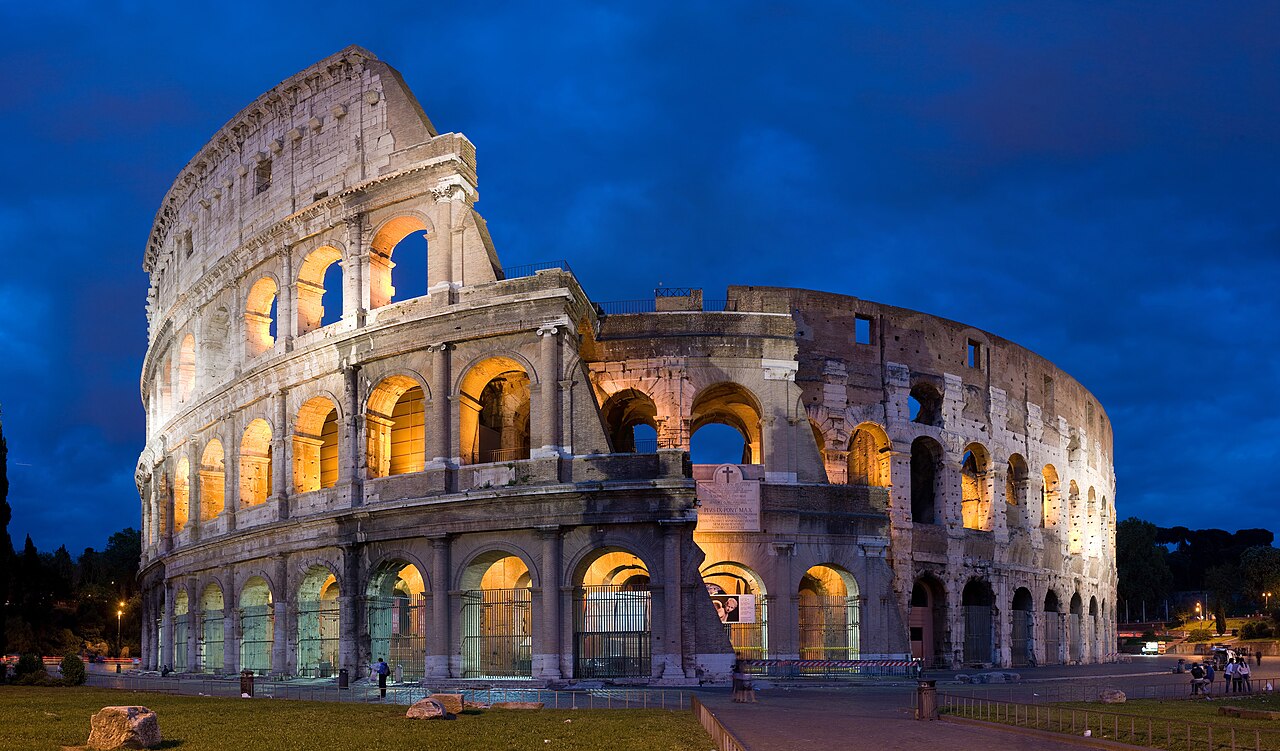
- 753 BC Romulus founds Rome, says the legend
- 509 BC The last king is expelled, the Republic begins
- 44 BC Julius Caesar is murdered
- 27 BC Augustus becomes the first emperor
- AD 80 The Colosseum opens
- 476 The last western emperor is deposed
- 1870 Italian troops take Rome; it becomes the capital
- 1929 Vatican City is created inside Rome
A city that started with a legend
The Romans told their own beginning as a story. Twin brothers, Romulus and Remus, were abandoned by the river Tiber, raised by a she-wolf and grew up to found a city. They quarrelled over where it should be, Romulus killed Remus, and the city took his name. The Romans dated it to 21 April 753 BC, and Rome still celebrates its birthday on that day.
Archaeologists have found that people lived on Rome's hills even before that date. What is certain is that early Rome was ruled by kings, and that in 509 BC the Romans threw out the last of them and swore never to have another.
The Republic, and the man who ended it
For almost five centuries Rome was a republic, run by elected magistrates and the Senate. It grew from one city into the master of the whole Mediterranean, defeating Carthage and taking Greece, Spain and much of North Africa.
Success brought civil wars. The most famous Roman of all, Julius Caesar, conquered Gaul, crossed the Rubicon with his army and made himself dictator. On the Ides of March, 15 March 44 BC, a group of senators stabbed him to death in a meeting hall next to the Theatre of Pompey. Its ruins are still visible today in Largo di Torre Argentina, in the middle of the city.
The emperors
Caesar's adopted son Octavian won the wars that followed, and in 27 BC the Senate gave him the name Augustus. He kept the old titles but held the real power, and became the first emperor. Rome then ruled for centuries over an empire that stretched from Britain to Egypt and Syria.
The emperors rebuilt the city in marble. After a great fire in AD 64 under Nero, his successors drained his private lake and built the Flavian Amphitheatre on the spot, the building we call the Colosseum. It opened in AD 80 under the emperor Titus and could hold around 50,000 people. A few decades later, Hadrian rebuilt the Pantheon, whose dome is still the largest unreinforced concrete dome in the world, about 1,900 years later.
From emperors to popes
In 313 the emperor Constantine allowed Christians to worship freely, and in 330 he moved the capital east, to a new city he named after himself, Constantinople. Rome lost its emperors. In 410 the Visigoths sacked it, and in 476 the last emperor of the West, a boy named Romulus Augustulus, was deposed. The eastern half of the empire went on for another thousand years, but Rome itself shrank to a fraction of its old size.
What kept it alive was the Church. The bishops of Rome, the popes, became its rulers and later the kings of a state across central Italy. In the Renaissance they turned it into a showcase: St Peter's Basilica was rebuilt over more than a century from 1506, and Michelangelo painted the ceiling of the Sistine Chapel between 1508 and 1512.
- Napoleon was here In 1809 Napoleon annexed Rome to the French Empire and had Pope Pius VII arrested and taken away.
- 1811 When his son was born, Napoleon gave him the title King of Rome.
- 1814 After Napoleon's fall, the Pope returned to Rome.
Capital of Italy, and a country inside it
In the 19th century Italy was unified around the kingdom of Piedmont. Rome was the last piece. On 20 September 1870, Italian troops broke through the walls at Porta Pia, and the next year Rome became the capital of Italy. The Pope refused to accept it and called himself a prisoner in the Vatican for almost 60 years.
The quarrel ended in 1929 with the Lateran Treaty, signed with Mussolini's government: the Pope recognised Italy, and Italy recognised Vatican City as an independent state. That is why the smallest country in the world sits in the middle of Rome. I told that part in countries inside another country.
After the Second World War, Italians voted in 1946 to end the monarchy, and Rome became the capital of the Italian Republic. Today it is a city of almost three million people living on top of 28 centuries of history.
See the story for yourself
The best thing about Rome is that you can walk through every chapter above in a few days. Here are the places, in the order of the story, with where to book them.
Getting there from the UAE
- Flights. Direct flights from Dubai and Abu Dhabi to Rome Fiumicino take around six and a half hours. Compare Dubai to Rome flights.
- Visa. UAE citizens do not need a visa for Italy for stays of up to 90 days in 180. Most other passport holders living in the UAE need a Schengen visa, and the application requires travel medical insurance covering at least EUR 30,000. EKTA says its Schengen travel insurance is suitable for visa applications. Always check the current rules with the Italian visa centre before you book.
- From the airport. Fiumicino is about 30 km from the centre. The Leonardo Express train runs to Termini station in about 32 minutes, or you can book a private airport pickup and be met at arrivals.
- Time difference. Rome is 2 hours behind the UAE in summer and 3 hours behind in winter.
- When to go. April, May, late September and October. July and August are hot, crowded and expensive.
Before you fly
- Mobile data. A travel eSIM is usually far cheaper than roaming. Airalo and Saily both sell Italy plans you can install before you leave.
- Plugs. Italy uses type C, F and L sockets, the UAE uses type G. Pack a universal travel adapter.
- Bags on the last day. Hotel checkout at noon and a night flight? Leave your luggage near Termini and keep exploring.
- Read on the plane. SPQR, by the Cambridge historian Mary Beard, is a popular and readable history of ancient Rome. Find it on Amazon.ae, or a Rome travel guide. Both are on Kindle.
Where to stay
- Centro Storico (around the Pantheon and Piazza Navona): you walk everywhere, at a price.
- Monti: next to the Colosseum and the Forum, with small streets and restaurants.
- Prati: quieter and a little cheaper, a short walk from the Vatican.
- Near Termini station: the most practical for the airport train, but check reviews carefully.
Questions people ask
How old is Rome?
According to legend, Romulus founded Rome on 21 April 753 BC, which makes the city about 2,780 years old. Archaeology shows people lived on its hills even earlier.
Do UAE citizens need a visa for Italy?
No. UAE citizens can visit Italy and the rest of the Schengen Area without a visa for up to 90 days in any 180-day period. Residents of the UAE with other passports usually need a Schengen visa, which requires travel medical insurance.
How long is the flight from Dubai to Rome?
A direct flight from Dubai or Abu Dhabi to Rome Fiumicino takes around six and a half hours.
Does one ticket cover the Colosseum and the Roman Forum?
Yes. The standard Colosseum ticket also covers the Roman Forum and the Palatine Hill, which are next to each other.
What plug adapter do I need for Rome?
Italy uses type C, F and L sockets, while the UAE uses type G, so you need a travel adapter.
The history is from the sources below. The travel tips are research from official and booking sites, not a personal trip report. Links to tickets, tours, flights, eSIMs, transfers, insurance and luggage storage may earn me a commission through Travelpayouts, and Amazon.ae links through Amazon Associates, at no extra cost to you. Full disclosure.
Sources
- Rome, Encyclopaedia Britannica
- History of Rome, Wikipedia
- Founding of Rome, Wikipedia
- Assassination of Julius Caesar, Wikipedia
- Colosseum, Wikipedia, and the official Parco archeologico del Colosseo
- Pantheon, Rome, Wikipedia
- Fall of the Western Roman Empire, Wikipedia
- Capture of Rome (1870), Wikipedia
- Lateran Treaty, Wikipedia
- Napoleon II, King of Rome, Wikipedia
- Vatican Museums, official site
- EU visa policy and the Schengen visa list, European Commission