
Egypt: the invasion that gave us the Rosetta Stone.
Napoleon arrived in Egypt in 1798 with an army and a team of scholars. A month after he landed his fleet was gone, and a year later he sailed home and left the army behind. Yet the expedition changed how the world sees ancient Egypt. Here is the story, and how to plan the trip from the UAE.
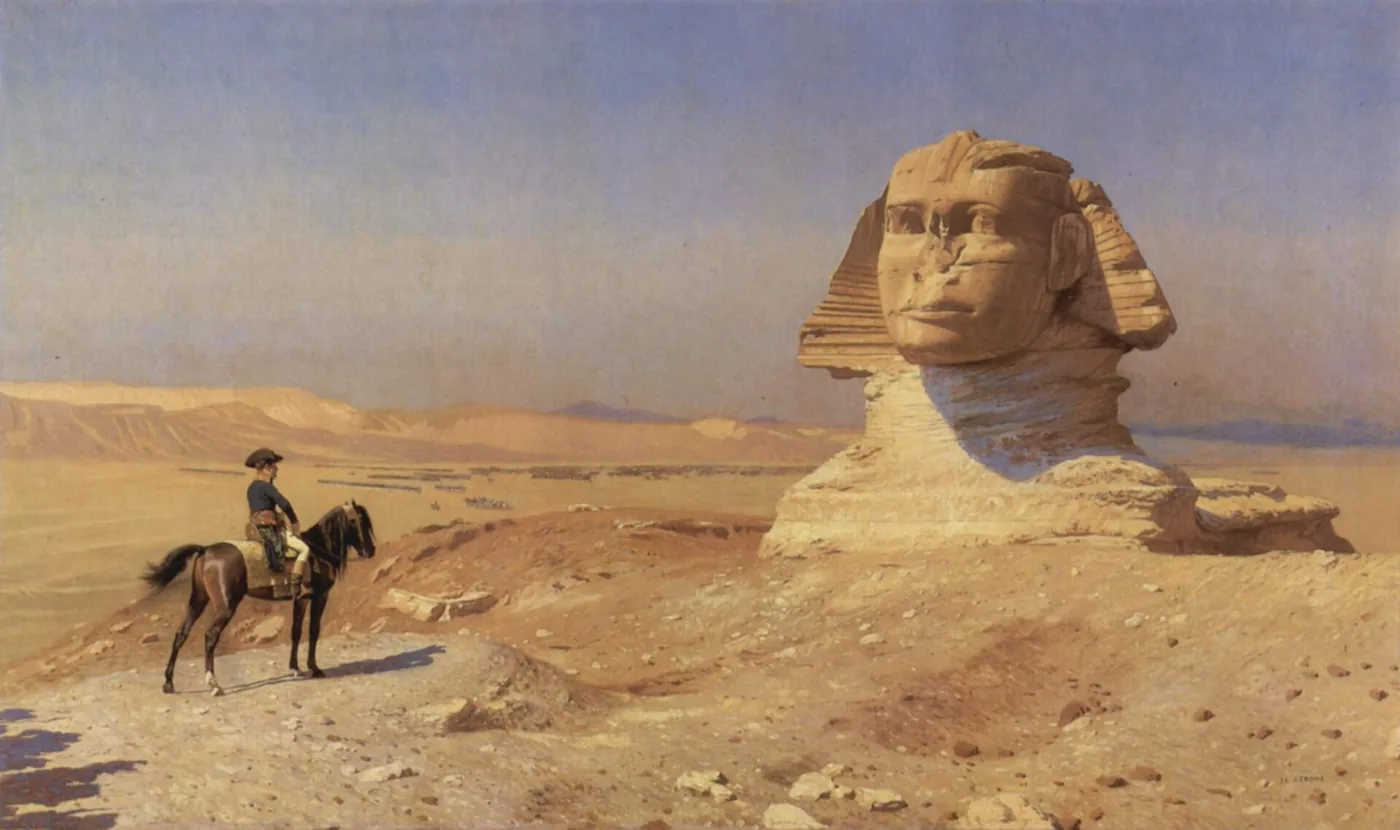
- 19 May 1798 Bonaparte sails for Egypt
- 21 July 1798 The Battle of the Pyramids
- 1 August 1798 Nelson destroys the French fleet at Aboukir Bay
- 22 August 1798 The Institut d'Égypte is founded in Cairo
- 21 October 1798 Cairo revolts against the French
- 19 July 1799 The Rosetta Stone is found
- 23 August 1799 Napoleon leaves Egypt
- 1822 Champollion reads the hieroglyphs
- 2025 The Grand Egyptian Museum opens
Why Egypt?
The Fondation Napoléon, which looks after the emperor's history, gives three reasons. There was a craze for all things Egyptian in 18th-century Europe. France's government, the Directory, wanted a very popular young general, fresh from his victories in Italy, as far from Paris as possible. And both the Directory and Napoleon hoped to hit Britain where it hurt, by threatening its route to India.
Malta, Alexandria, Cairo
Napoleon sailed from Toulon on 19 May 1798, took Malta on 11 June, and landed near Alexandria on 1 July. The city fell the next day. Then he marched on Cairo.
On 21 July the French met a Mamluk army of around 6,000 men. The battle is called the Battle of the Pyramids, but it was fought on the west bank of the Nile near Embabeh, with the pyramids only in the distance. The French stood in squares, repelled the Mamluk charge, and won. Napoleon entered Cairo days later.
Days later, the fleet
On 1 August 1798 the British admiral Nelson found the French fleet anchored in Aboukir Bay, about 20 miles east of Alexandria, and attacked at dusk. By the end, the French had lost eleven warships and two frigates, with about 1,700 dead. It is remembered as the Battle of the Nile, and it left Napoleon's army stranded: without ships, France could no longer supply or reinforce Egypt properly.
The scholars
Napoleon had not come only with soldiers. He brought scientists and artists, and on 22 August 1798 he founded the Institut d'Égypte in Cairo. They measured monuments, drew animals and plants and recorded how people lived. Their work became the multi-volume Description de l'Égypte, published in France from 1809 onwards, which set off a European craze for Egyptology.
On 19 July 1799 the expedition found a slab of black stone near the town of Rosetta, on the Nile delta, carrying the same decree in three scripts: hieroglyphs, Demotic and Greek. Nobody had been able to read hieroglyphs for about 1,400 years. With the Greek as a guide, the French scholar Jean-François Champollion finally worked out how they function in 1822.
Leaving the army behind
Things did not go well on land either. Cairo rose against the French on 21 October 1798, a reminder that for Egyptians this was a foreign invasion, not an archaeological trip. Napoleon marched into Syria, but after a failed siege of Acre he lifted it on 10 May 1799. On 23 August 1799 he slipped out of Egypt and went home, leaving the army to its fate.
The French held on until 1801, when they surrendered to a British force. Under the terms of the surrender the Rosetta Stone went to Britain, and it is in the British Museum in London today.
See the story for yourself
Egypt is a very big trip, so pick a few places and start with the ones from the story.
Getting there from the UAE
- Flights. About four hours from the UAE to Cairo. Compare Dubai to Cairo flights.
- Visa for UAE citizens. Egypt's official e-Visa portal lists the United Arab Emirates among the nationalities that can get an e-Visa, 30 US dollars for a single entry and 65 for multiple entries. It asks you to apply at least 7 days before you fly. Some other sources say Gulf citizens can enter without a visa. The portal does not say that, so confirm with the Egyptian embassy before you book.
- If you live in the UAE on another passport, your passport decides. Only the nationalities on the portal's list can use the e-Visa, so check yours there first.
- What the portal asks you to bring. A passport valid for at least 6 months from arrival, the e-Visa printout, your itinerary and your hotel booking. Entry is always at the border officer's discretion.
- When to go. The cooler months, roughly November to March, are far better for walking around the pyramids.
- Plugs. Egypt uses two-pin European sockets, so bring an adapter for your UAE plugs.
Before you fly
- Mobile data. Airalo sells an Egypt eSIM you can install before you leave.
- Travel insurance. EKTA travel insurance covers medical care abroad.
- A plug adapter. See travel adapters on Amazon.ae.
- A book for the long drives. Which Kindle to buy.
Questions people ask
Why did Napoleon invade Egypt?
Partly to cut Britain's route to India, partly because the French government wanted a dangerously popular general far from Paris, and partly because of a fashion for everything Egyptian in 18th-century Europe.
Where was the Battle of the Pyramids fought?
On 21 July 1798 on the west bank of the Nile near Embabeh, with the Giza pyramids visible in the distance. A Mamluk army of about 6,000 attacked the French, who were formed in squares, and lost.
Who found the Rosetta Stone, and where is it now?
The French expedition found it near Rosetta in July 1799. After the French defeat in Egypt it passed to Britain, and it is in the British Museum in London.
Do UAE citizens need a visa for Egypt?
Egypt's official e-Visa portal lists the United Arab Emirates among the nationalities that can get an e-Visa, at 30 US dollars for a single entry. Some other sources say Gulf citizens can enter without a visa, and the portal does not say that, so confirm with the Egyptian embassy before you book.
Is the Grand Egyptian Museum open?
Yes. It opened to the public in November 2025 near the Giza pyramids, and it sells tickets on its official website, visit-gem.com.
The history is from the sources below. The travel tips are research from official and booking sites, not a personal trip report, and entry rules change, so check the official pages before you fly. Links to tickets, tours, flights, eSIMs and insurance may earn me a commission through Travelpayouts, and Amazon.ae links through Amazon Associates, at no extra cost to you. The government, museum and Wikipedia links are plain links. Full disclosure.
Sources
- The Campaign in Egypt, Fondation Napoléon (chronology, the reasons for the expedition, the Battle of the Nile)
- Battle of the Pyramids, New World Encyclopedia (the battlefield near Embabeh)
- Rosetta Stone, Wikipedia (the three scripts, the surrender of 1801, Champollion)
- Description de l'Égypte, National Library of Scotland
- e-Visa FAQ, Egypt e-Visa Portal, Ministry of Interior (official)
- Grand Egyptian Museum, official ticketing website
- Turnout continues to surge one week into the GEM's official opening, Enterprise, November 2025